


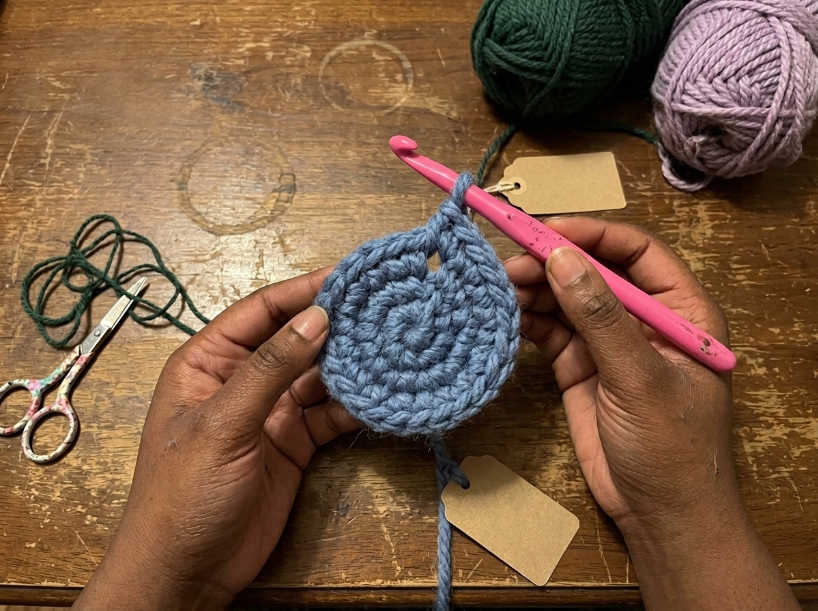
Crocheting continuously without joining at the end of each round creates a seamless spiral, but the round boundary is no longer fixed. As the work progresses, the beginning-of-round position advances around the piece, which can make color changes, shaping lines, and other vertical details appear to slant diagonally.
The Short Answer
Amigurumi spirals lean because single crochet worked continuously in the round climbs diagonally rather than stacking vertically. You can change the appearance of this slant by switching to the denser “yarn under” technique (X-stitch), or reduce the color jog entirely by using joined rounds. If you prefer to keep the spiral, shift stitches can help rotate the jog to the back of the piece.
How to Spot the Problem
If you crochet a solid-colored stuffed ball, the diagonal lean is completely invisible. The fabric looks seamless. However, the mechanical reality of the spiral becomes painfully obvious the moment you introduce horizontal stripes or specific facial shaping.
Because the color change occurs within a continuous spiral, the new color begins at an offset position from the previous round, producing the familiar diagonal jog. Similarly, if a pattern asks you to place six decreases in a vertical column to shape a belly, that column can gradually appear to drift around the piece as the continuous rounds progress.
Many beginners assume this drift is caused by twisted yarn or accidental skipped stitches, but the underlying spiral progression is a structural consequence of working continuously without joining. Each round rests slightly forward and higher than the one below it.
| Symptom | Likely cause | Fix |
|---|---|---|
| Stripes have a jagged step | Continuous spirals climb diagonally. | Use joined rounds for the striped section, or use shift stitches to hide the jog on the back. |
| Color change looks messy or two-toned | Finishing the old stitch completely before switching colors. | Switch to the new color on the final pull-through of the last stitch of the old color. |
| Vertical shaping drifts diagonally | Standard yarn-over stitches (V-stitch) have a strong natural lean. | Switch to the yarn-under (X-stitch) method to create denser, straighter stitches. |
Root Causes
The natural lean is an unavoidable feature of crocheting in the round without slip-stitch joins. That said, the degree of the lean is heavily influenced by how you hold and wrap your yarn.
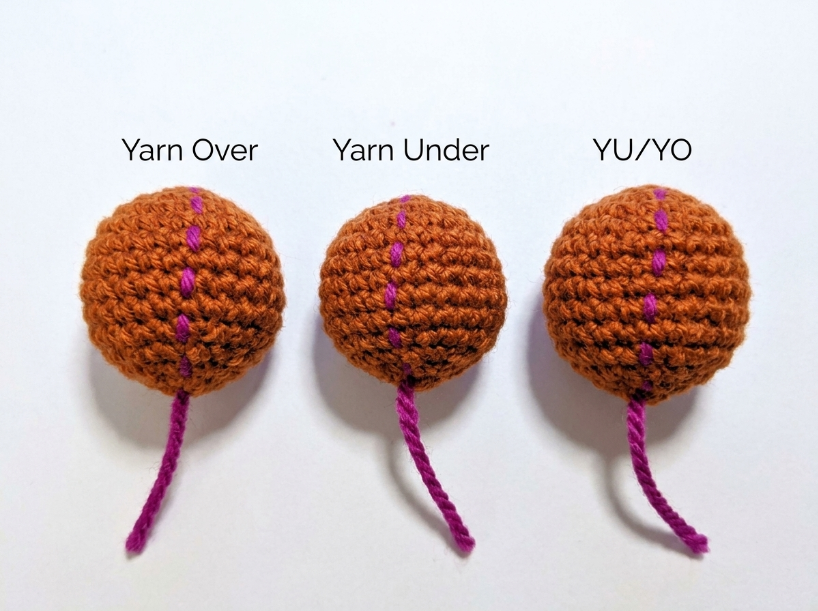
The traditional crochet method is “Yarn Over” (YO), where you wrap the yarn over the hook from back to front. This creates a flexible, V-shaped stitch. While great for garments, the V-stitch has a pronounced natural slant when worked in a tight spiral.
If you look closely at many amigurumi pieces, you may see X-shaped stitches produced by the yarn-under (YU) technique. Yarn-under can create a shorter, denser stitch than the traditional yarn-over method, which can change the appearance of the fabric and sometimes make color-change jogs less pronounced. That said, it does not eliminate the underlying spiral progression of continuous rounds.
Fixes
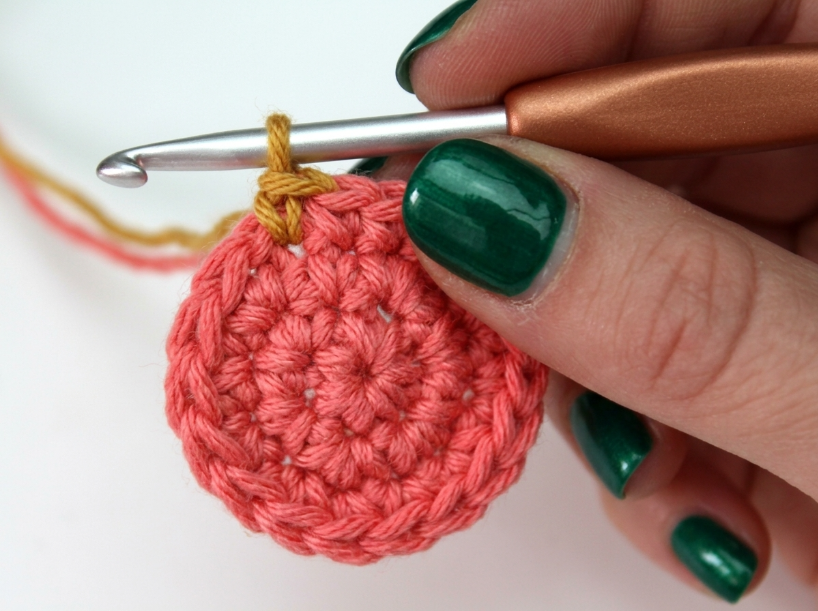
For a clean conventional color change, introduce the new color during the final pull-through of the preceding stitch. Work the last stitch of the old color until you have two loops left on your hook. Instead of pulling through with the old color, drop it, yarn over with the new color, and pull it through both loops. Your next stitch is now entirely the new color. Finishing the stitch completely in the old color before switching is a common mistake that creates a messy, two-toned top loop.
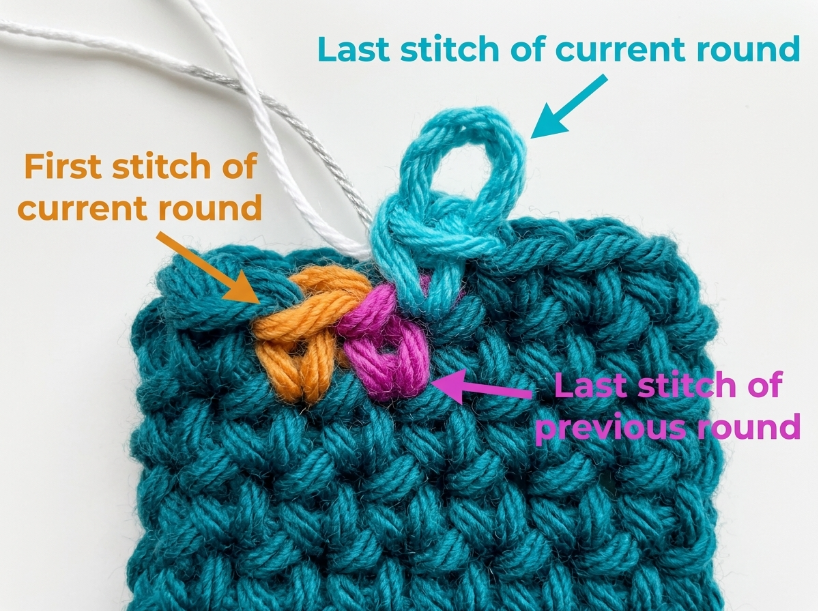
If you want consistently level horizontal stripes, joined rounds are one of the most reliable approaches. Specialized jogless or invisible color-change techniques can also reduce the visible jog while keeping the work in continuous rounds. At the end of the round, slip stitch into the first stitch, chain one, and begin the next round in the same stitch. The join establishes a fixed round boundary, making it much easier to align the new color consistently with the previous round. The tradeoff is that joining creates a visible vertical seam line running up the toy.
If you hate the seam line but want to manage the diagonal lean, use shift stitches. A shift stitch generally involves working one or more additional stitches before repositioning the stitch marker, moving the beginning-of-round position to a different location. This doesn’t eliminate the spiral, it can reposition the visible jog or shaping line to a less noticeable area.
How to Prevent It
The best prevention is choosing the right technique for the visual priority of the piece. If you are making a bee with high-contrast yellow and black stripes, joined rounds are usually worth the seam line to keep the stripes perfectly flat. If you are making a solid-colored bear, a continuous spiral is vastly superior because it leaves no seam.
If you struggle with extreme drifting, try switching your technique to yarn-under (X-stitch) for the entire project. The denser, shorter stitches can change the appearance of shaping lines and color-change jogs compared with traditional yarn-over stitches, but they do not remove the underlying spiral structure.
| Technique | Why use it | Limitation |
|---|---|---|
| Yarn Under (X-stitch) | Creates a denser, often shorter stitch that can alter the appearance of spiral jogs. | Creates a stiffer fabric, can be harder on the wrists. |
| Clean Color Change | Prevents two-toned, messy stitches at the color boundary. | Does not eliminate the geometric height step (the jog). |
| Joined Rounds | Creates perfectly level, jogless horizontal stripes. | Leaves a visible vertical slip-stitch seam line. |
| Shift Stitches | Rotates the round to hide the jog on the back of the piece. | Requires careful counting to maintain shaping alignment. |
Questions You Might Still Have
Q: What is the easiest way to minimize the spiral jog for a beginner?
Use the clean color change method (switching colors on the final pull-through of the stitch) and consciously place the color change at the back of the toy. For high-contrast stripes where a step is unacceptable, practicing joined rounds is the most reliable long-term solution.
Q: Does changing hook size fix the spiral lean?
No. Dropping a hook size will make your fabric denser and help prevent stuffing from showing through, but it will not change the geometric reality of a continuous spiral. Changing to joined rounds changes the round structure, while yarn-under, tension, hook size, yarn, and stitch type can all affect the density, height, and appearance of the resulting fabric. None of these changes the basic fact that continuous rounds progress without a fixed round boundary.
Q: Why does my color change still look messy even when I join rounds?
If you are joining rounds and the color change still looks uneven, keep the joining slip stitch consistent with the tension of the surrounding stitches. If it is unusually loose or tight, the join can become more visible or distort the color transition.
Q: Does it matter if I crochet left-handed?
Left- and right-handed crocheters can produce mirrored-looking spiral orientations, depending on how the work is held and viewed. The underlying continuous-round construction is the same. When applying shift stitches, a left-handed crocheter will need to account for this mirrored drift when hiding their jogs.
📅 Last reviewed: August 2026 · This article is reviewed every 12 months.
Summary
Amigurumi spirals lean because continuous unjoined rounds climb uphill instead of stacking flat, creating a visible jog at color changes and causing shaping to drift. You can change the appearance of the drift by using a denser yarn-under (X-stitch) construction, while joined rounds provide a fixed round boundary that can greatly reduce the traditional horizontal color jog. Specialized jogless color-change techniques can also reduce the jog without joining every round. The clean color change method-pulling the new color through on the final step of the old stitch-is essential for keeping the transition sharp, regardless of which structural method you choose.

