


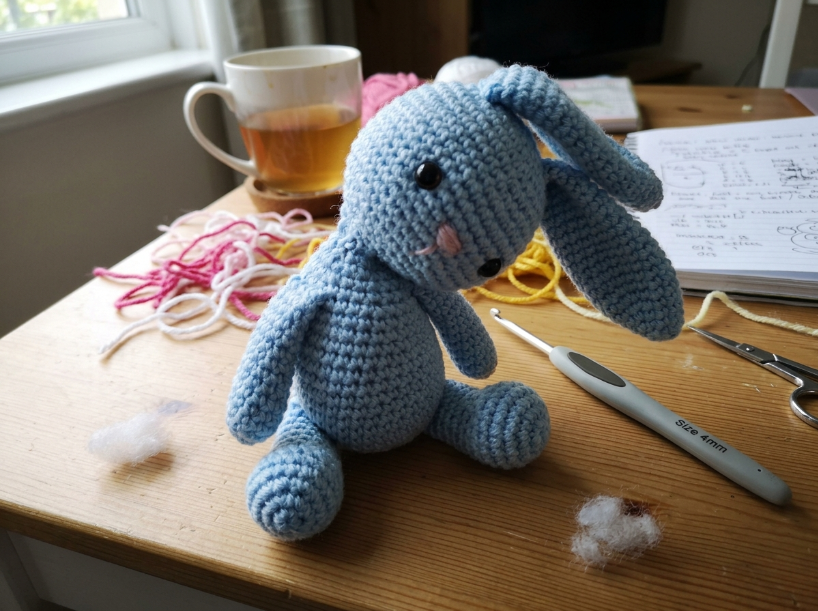
Gravity is the enemy of a heavy amigurumi head, especially when it sits on a narrow neck. Even if the stitches are tight and the head is perfectly round on its own, attaching it to a small base often results in a toy that slumps forward or leans to the side.
The Short Answer
A floppy head occurs when the neck lacks the internal structure to support the head’s weight. The most reliable fix is to insert a firm internal support-such as a flexible foam curler, a tightly stuffed crocheted tube, or a plastic dowel-through the neck and into the head. Relying solely on a narrow column of polyester stuffing is rarely enough to keep a large head upright over time.
How to Spot the Problem
Many guides state that tight tension prevents amigurumi problems, and while tension is crucial for keeping stuffing from showing, it does not guarantee structural stability. One important structural factor is the relationship between the head’s mass, the neck’s dimensions, and the way the head is attached. If the neck opening is extremely narrow compared to a heavy, oversized head, the head has very little surface area to rest on. The heavy head creates a larger torque around the neck attachment point, making forward or sideways tilting more likely.
The easiest test is to hold the finished head upright before attaching it to the body. If the head feels dense and heavy but the neck opening is very small, standard stuffing will likely compress under the load. If you suspect the neck will not hold, you may need to add structural support before sewing the pieces together. For readers working on their first large amigurumi project, understanding how stuffing compression affects structural integrity is a critical first step.
| Symptom | Likely cause | Fix |
|---|---|---|
| Head tilts forward after attaching to body | Neck lacks internal structural support to bear the weight. | Insert a foam hair curler or a crocheted neck tube into the neck before fully sewing. |
| Head feels squishy and loses round shape | Insufficient stuffing density inside the head itself. | Add more polyfil in small increments until the head is completely firm. |
| Head sags to one side | Uneven stuffing distribution or asymmetric neck attachment. | Redistribute stuffing evenly and check that the neck is centered on the body. |
| Head holds shape off the body but flops when attached | The neck fabric stretched during assembly or the body is too narrow. | Use a smaller hook for the neck rounds and stuff the neck firmly enough to resist significant compression. |
Root Causes
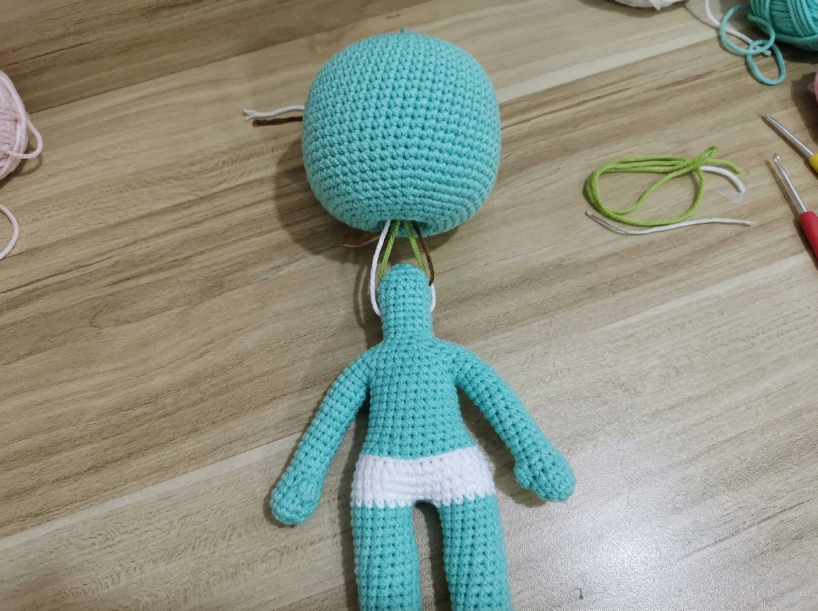
The most common structural failure happens when a pattern creates a very narrow neck to support an oversized head. While a narrow neck looks cute, the small contact area cannot distribute the head’s weight effectively. The head’s mass presses down on the neck fabric, the polyfil stuffing inside the neck compresses, and the stitches stretch outward, creating a forward tilt.
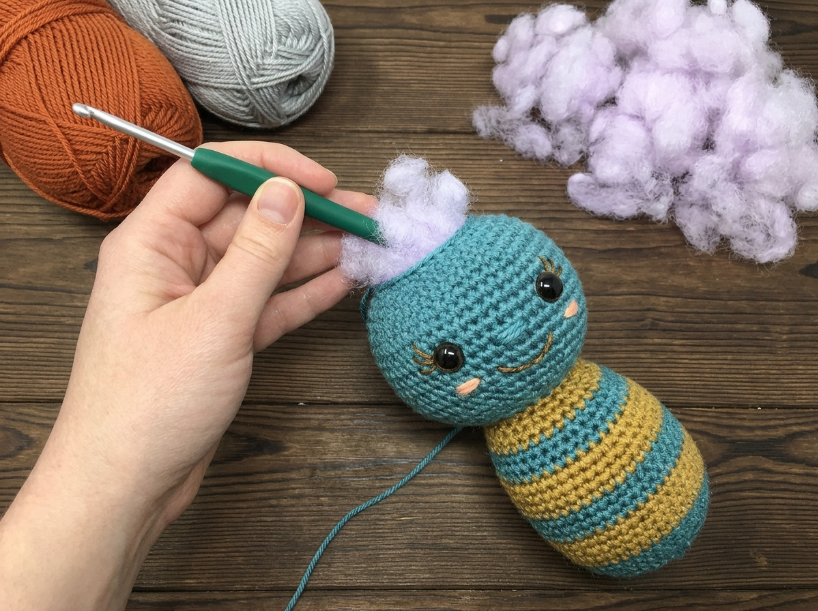
Polyester fiberfill can compress or redistribute with repeated handling, depending on the type of fill and how heavily the toy is handled. This can contribute to a head becoming softer or less stable over time. The stuffing material simply cannot act as a rigid spine. If you are working on a large amigurumi with a heavy head, an internal support acts as a skeleton, adding the vertical stability that polyfil alone cannot provide.
Fixes
One practical approach is to create a “neck tunnel” (or internal neck post) combined with a suitable support. Rather than just sewing a flat head to a flat neck, you insert a support column deep into both pieces.
Flexible foam hair curlers (the wire-core type) can provide internal support in some larger decorative amigurumi. Choose a product that fits securely inside the piece and cannot work its way through the fabric. Because these are not generally designed as toy components, avoid presenting them as automatically safe for young children. Insert the foam curler through the center of the body’s neck and push it up into the head until it reaches the top of the stuffing.
If you prefer an entirely yarn-based solution, you can crochet a separate “neck tube.” Crochet a tight cylinder in single crochet, stuff it firmly, and insert this tube into the neck opening, extending it up into the head. This yarn-based approach avoids adding a rigid internal object, but the finished toy should still be assessed for age suitability, secure stitching, and small-part hazards.
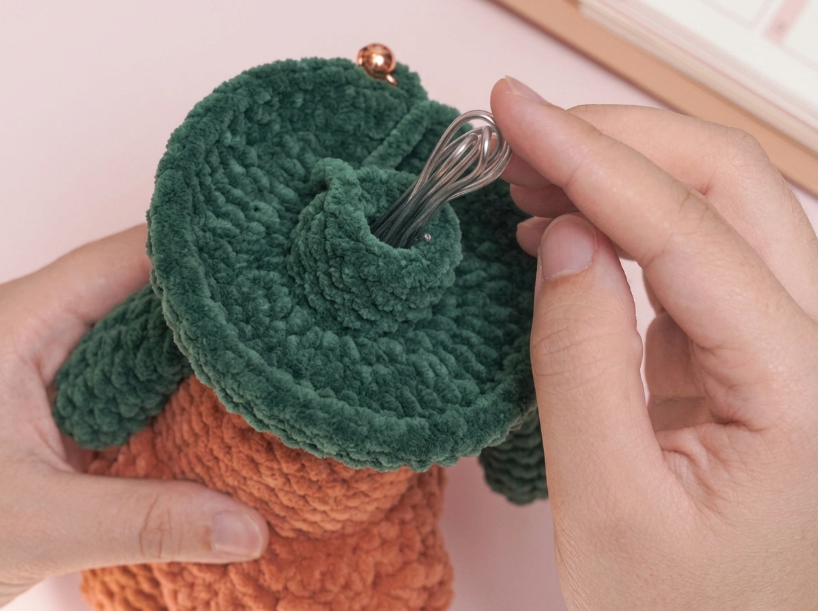
For display-only pieces, some makers may use rigid internal objects such as wooden dowels or thick plastic tubes for additional support. These should not be presented as suitable for children’s toys because rigid components can break, shift, or work through the fabric.
How to Prevent It
The most reliable prevention is to plan for a neck support from the beginning of the project, especially for dolls with large heads. When crocheting the body, you can intentionally extend the neck stitches higher to create a longer internal post that the head will slide over, rather than just resting on top.
Stuff the neck firmly enough to resist significant compression while keeping the stitches closed and the fabric free from excessive strain. In practice, most crocheters understuff the neck rather than overstuff, which is why heads that look fine during assembly develop a flop after a few days of handling.
Additionally, when attaching the head to the body, sew them together using multiple rounds of stitching. Do not just sew one simple circle around the edge, take extra passes to ensure a wide, secure base. You can also use your yarn needle to sew a long anchoring stitch from the inside of the neck to the upper back of the body, which acts as a “stay” to hold the head backward.
| Internal Support | Why | Limitation |
|---|---|---|
| Flexible foam curlers | Provides strong vertical support with a soft exterior. | Requires purchasing a specific non-yarn item, assess child-safety. |
| Crocheted neck tube | Avoids adding a rigid internal object and uses only yarn. | Takes extra time to crochet and must be stuffed very firmly. |
| Wooden dowel or thick straw | Provides rigid internal support for display-only pieces. | Not safe for children, can poke through fabric or break. |
| Extra polyfil stuffing | Increases density to slow down compression. | Often not enough on its own for very large heads. |
Questions You Might Still Have
Q: Why does my amigurumi head keep flopping even when I follow the pattern?
Many patterns prioritize aesthetics over structural engineering. A pattern written with a very narrow neck may look cute in photos, but if the designer did not specify an internal support, the heavy head will naturally flop. You must add your own internal support (like a foam curler) if the neck-to-head ratio is extreme.
Q: How do I fix a floppy head without starting over?
If the head is already attached, you can try to “sculpt” the neck area. Take a long piece of matching yarn and thread it through the body and head multiple times, pulling tightly to stabilize the connection, then knot it securely. If it still flops, you may need to partially detach the head, insert a foam curler or crocheted tube, and re-sew it.
Q: Is a floppy head caused by tension, hook size, or the yarn?
The primary cause is the lack of internal structural support combined with a heavy head on a narrow neck. While tight tension and a smaller hook size help create a denser fabric that holds stuffing better, they cannot overcome gravity if the head is simply too heavy for the neck opening.
Q: Can I use plastic pellets in the neck to fix a floppy head?
No. Plastic pellets are usually better suited to adding weight at the base of a toy than providing vertical support inside a narrow neck. They won’t act like a rigid post, so they may not solve a floppy-head problem by themselves. They can also leak through the stitches if not contained in a pouch.
Q: How do I prevent a floppy head in my next project?
Plan for internal support immediately. Keep flexible foam curlers on hand, or crochet a small, densely stuffed tube to act as a spine. Stuff the neck firmly enough to resist significant compression without forcing the stitches apart, and sew the head to the body with multiple, secure passes of yarn.
Q: Does a floppy head affect the whole project or just certain rows?
A floppy head is a localized structural issue at the neck attachment point. Fixing the neck opening or adding internal support at the neck base resolves the problem without requiring changes to the rest of the body or limbs.
📅 Last reviewed: August 2026 · This article is reviewed every 12 months.
Summary
A floppy amigurumi head usually results from a mismatch between the head’s weight and the stiffness or support provided by the neck and attachment. Stuffing, fabric density, proportions, and internal support can all affect the result. The fix often involves inserting a firm internal support-such as a flexible foam hair curler, a stuffed crocheted tube, or a wooden dowel-deep into both the body and the head. For disproportionately large or heavy heads, an appropriate internal support can provide more reliable posture than stuffing alone.

