


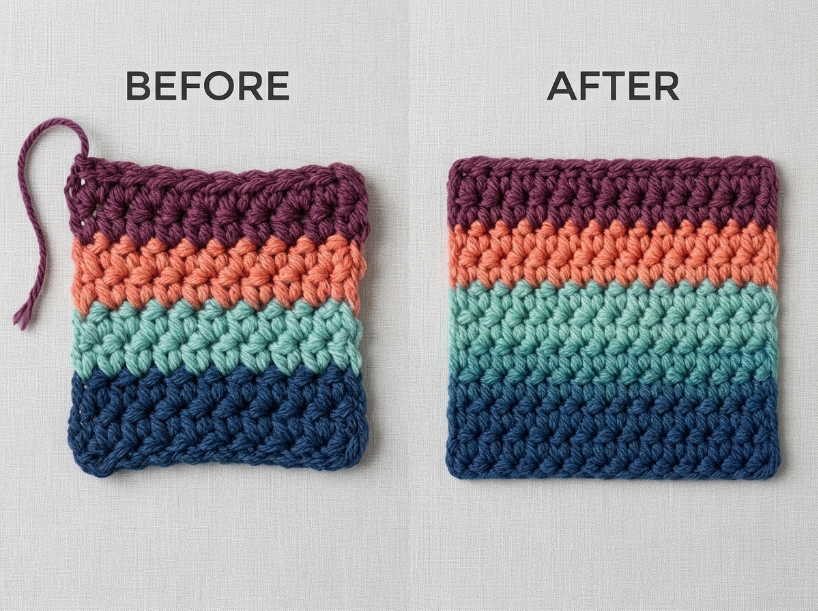
You finish a few rows, hold your crochet up, and notice something is off: one edge is higher than the other, the fabric is wavy, or random sections look tighter and lumpier than the rest. It can happen even when you’re following the pattern carefully.
The good news is that uneven crochet usually has a small number of identifiable causes. The key is figuring out whether you’re dealing with tension, stitch-count errors, edge technique, or the way the fabric is being shaped.
The Short Answer
Uneven crochet is most often caused by inconsistent tension, accidentally adding or skipping stitches, or working the edges differently from row to row.
Before changing your hook or restarting, count the stitches in your current row. If the stitch count is wrong, correct that first. If the count is correct but the fabric is still uneven, check your tension, hook size, turning-chain technique, and foundation chain.
For projects where measurements matter, make a gauge swatch using the same yarn, hook, stitch, and technique you’ll use in the finished piece.
How to Spot What’s Going Wrong
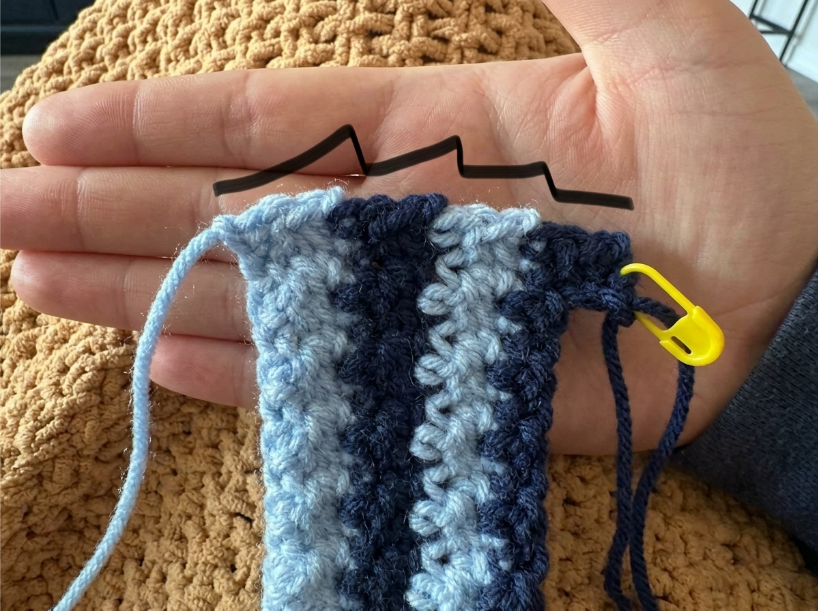
Start by looking at the shape of the fabric, rather than immediately assuming your tension is the problem.
If one edge gradually moves inward or outward, check your stitch count from row to row. A missing stitch can make an edge contract, while an extra stitch can make it expand.
If both edges flare outward and the fabric develops waves or ruffles, you may be working more stitches than intended.
If the bottom edge curls tightly, the foundation chain may be too tight compared with the stitches worked into it.
If isolated sections look noticeably tighter or looser while the overall stitch count is correct, inconsistent tension is a more likely explanation.
Quick Diagnostic Table
| Symptom | Likely cause | First thing to check |
|---|---|---|
| One edge gradually shifts | Added or skipped stitches | Count every row |
| Both edges flare or ruffle | Too many stitches | Check stitch count and where you’re inserting the hook |
| Bottom edge curls | Tight foundation chain | Try a larger hook for the foundation chain |
| Random tight or loose spots | Changing tension | Compare stitch size across several rows |
| Fabric is stiff and distorted | Hook too small or tight tension | Try a larger hook |
| Fabric is very loose with large gaps | Hook too large or loose tension | Try a smaller hook |
| Edges have inconsistent height | Edge/turning technique varies | Check how you work the first and last stitches |
Check Your Stitch Count First
A gauge swatch won’t fix an accidentally added stitch.
For a rectangular project, count the stitches at the end of a few consecutive rows and compare the number with the pattern.
If the pattern calls for 30 stitches and you have 31, find where the extra stitch entered before continuing. If you have 29, look for the skipped stitch.
This matters because a stitch-count error can compound as you continue. An extra stitch in one row can make the next row longer, while a missed stitch can gradually pull an edge inward.
A stitch marker can make the edges easier to identify. Place one in the first or last stitch when you’re having trouble seeing exactly where a row begins or ends.
For projects worked in continuous rounds, use a stitch marker to identify the beginning of each round and follow the pattern’s increases and decreases carefully.
Tension Can Change While You Crochet
Even if your tension is consistent at the beginning, it can change as you continue working.
Your grip may tighten when you’re concentrating. Your hands may relax after you’ve been crocheting for a while. Changing your sitting position can also affect how you hold the yarn and hook.
You don’t need to force yourself to maintain exactly the same hand pressure throughout an entire project. Instead, aim for a comfortable, repeatable motion.
Look at several stitches together rather than judging one stitch individually. If the stitches are generally similar in size and the stitch count is correct, small variations usually aren’t a structural problem.
For projects where measurements are important, a gauge swatch is still useful because it tells you whether your combination of yarn, hook, and tension produces the dimensions the pattern expects.
Your Hook Size Matters
Hook size affects the size and density of your stitches.
A smaller hook generally produces smaller, tighter stitches, while a larger hook generally produces larger, looser stitches when the same yarn and technique are used.
If your fabric is much tighter than the pattern’s gauge, try a larger hook.
If your fabric is much looser, try a smaller hook.
Don’t choose a hook solely from the yarn label, though. Yarn-label recommendations are a starting point, not a guarantee that you’ll match a particular pattern’s gauge.
For amigurumi, for example, crocheters commonly use a smaller hook than the yarn label suggests to produce a dense fabric with smaller gaps.
Don’t Ignore the Foundation Chain
A common cause of uneven crochet is a foundation chain that’s tighter than the first row.
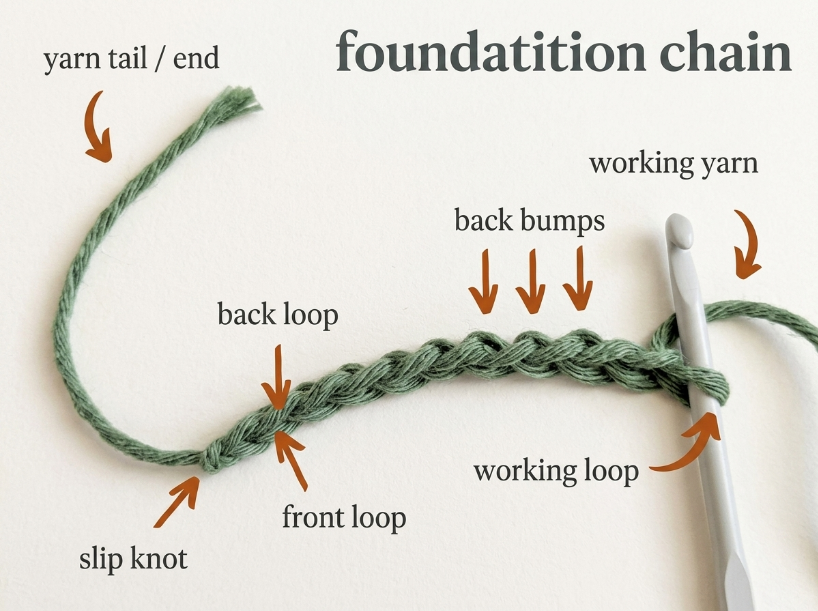
The chain has less stretch than the stitches you’re working into, so the finished piece can curl or pull inward along the bottom edge.
One simple solution is to make the foundation chain with a slightly larger hook and then switch to your regular hook for the first row.
You can also use a foundation stitch such as foundation single crochet when the pattern allows it. Foundation stitches create the base and stitches together, which can produce a more flexible starting edge.
If you’re already several rows into a project, however, changing your foundation technique won’t repair the existing edge. At that point, determine whether the curl is minor and can be improved with blocking or whether the foundation needs to be redone.
Turning Chains Can Affect Your Edges
Turning-chain conventions vary between patterns, so don’t assume there is one universal rule.
Some patterns count the turning chain as the first stitch; others don’t. Some crocheters chain one for single crochet and work directly into the first stitch, while other techniques use different approaches.
The important thing is to follow the pattern’s stated instructions consistently.
If you suddenly start treating the turning chain as a stitch when the pattern doesn’t, or stop treating it as one when the pattern does, your stitch count and edge shape can change.
When a pattern doesn’t clearly explain its turning-chain convention, look at the stitch count and instructions for the first and last stitches of each row rather than relying on a generic rule.
Blocking Can Improve Minor Unevenness
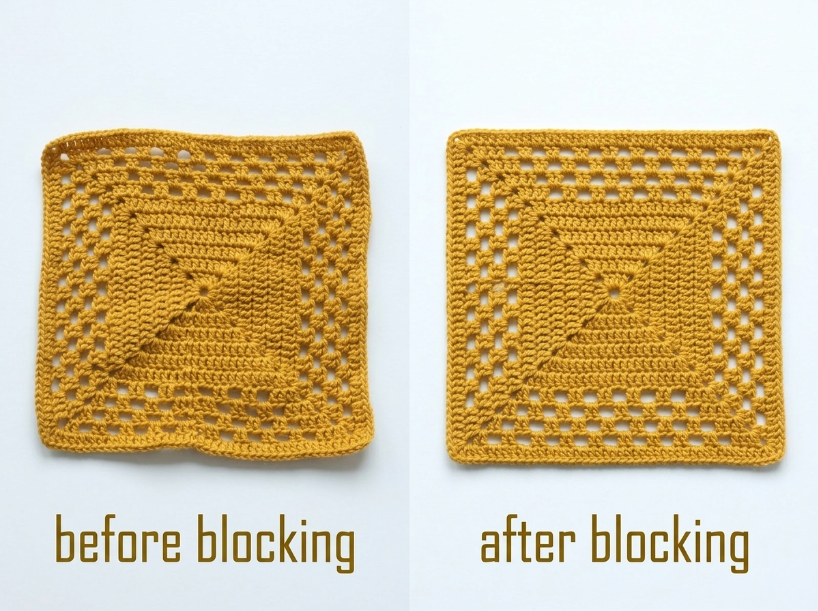
Blocking can make a finished crochet piece look considerably more even, but it has limits.
Blocking can help relax fibers and reshape minor irregularities, particularly in fibers that respond well to moisture and shaping, such as wool and some cotton projects.
It cannot correct missing or extra stitches.
If your edge waves because you’ve accidentally added stitches, blocking won’t magically remove those stitches. You’ll simply end up with a blocked piece that still has the underlying structural problem.
Always check stitch count and construction before reaching for blocking.
For acrylic yarn, heat-based blocking methods can permanently reshape the fibers, so use appropriate care rather than assuming that every fiber should be treated the same way.
How to Prevent Uneven Crochet
You don’t need to count every stitch repeatedly throughout an entire project.
Instead, use a few simple checkpoints:
- Check your stitch count regularly, especially during the first several rows.
- Mark the beginning or end of rows when it’s difficult to identify the edge stitch.
- Keep your working position reasonably consistent during gauge-sensitive projects.
- Compare your fabric against the pattern measurements rather than relying only on appearance.
- Fix stitch-count errors immediately instead of hoping they disappear later.
- Use the same yarn and hook combination for your gauge swatch and project.
For large projects, periodically lay the work flat and look at the overall shape. It’s much easier to correct a problem after five rows than after fifty.
What to Do When Your Project Is Already Uneven
Don’t automatically unravel everything.
First, determine where the problem began.
If the last few rows are uneven but the earlier fabric looks correct, unravel back to the last good row and continue from there.
If the stitch count changed several rows ago, find the first incorrect row and correct it before continuing.
If the stitch count is correct and the fabric simply has minor tension variations, you may be able to continue and block the finished piece later.
If the entire project is significantly different from the required dimensions, however, restarting with a different hook size or adjusted tension may save time compared with trying to force the finished piece into shape.
A Simple Decision Guide
| Problem | Should you unravel? |
|---|---|
| One missed stitch in the previous row | Usually yes |
| Extra stitch causing the edge to flare | Yes, if the error is visible |
| Minor tension variation | Usually no |
| Slight curling foundation edge | Not necessarily |
| Major gauge mismatch | Usually worth restarting |
| Minor irregularity that blocking can improve | Usually no |
Common Questions
Why does my crochet look uneven even though I have the correct stitch count?
Correct stitch count doesn’t guarantee identical tension. You can have the same number of stitches in every row while producing some stitches tighter or looser than others. Look at the overall fabric and compare stitch size across several rows.
Why are my crochet edges getting wider?
First check whether you’re accidentally adding stitches, particularly at the beginning or end of rows. Also check whether you’re consistently working into the correct first and last stitches.
Why is my crochet curling at the bottom?
A tight foundation chain is one common cause. Try making the foundation chain with a larger hook, or use a suitable foundation-stitch technique. Stitch pattern and yarn choice can also contribute to curling.
Can blocking fix uneven crochet?
Blocking can improve minor tension irregularities and reshape some fabrics, but it cannot correct incorrect stitch counts or major construction errors.
Should I use a bigger or smaller hook?
If your fabric is tighter or smaller than the pattern’s gauge, try a larger hook. If it’s looser or larger, try a smaller hook. Make a gauge swatch before committing to a large project when the finished dimensions matter.
Do I need to count every row?
You don’t necessarily need to count every stitch in every row forever, but checking regularly is especially useful early in a project and whenever the pattern contains increases, decreases, or complicated stitch placement.
Should I restart an uneven project?
Only if the unevenness affects the finished shape, dimensions, or appearance enough to matter. Minor tension differences are normal and often become less noticeable after finishing and, where appropriate, blocking.
Final Takeaway
Uneven crochet isn’t automatically a sign that you’re doing something wrong. Start with the simplest diagnosis: check the stitch count, then check your tension and hook size. If the structure is correct, minor irregularities may not require any correction at all.
When the problem is significant, find the first row where the fabric went wrong and fix it there rather than continuing and allowing the error to compound. With regular stitch-count checks, an appropriate hook size, and a little attention to tension, most uneven-crochet problems can be caught long before you have to finish an entire project and start over.
📅 Last reviewed: August 2026
This article is reviewed every 12 months.

