


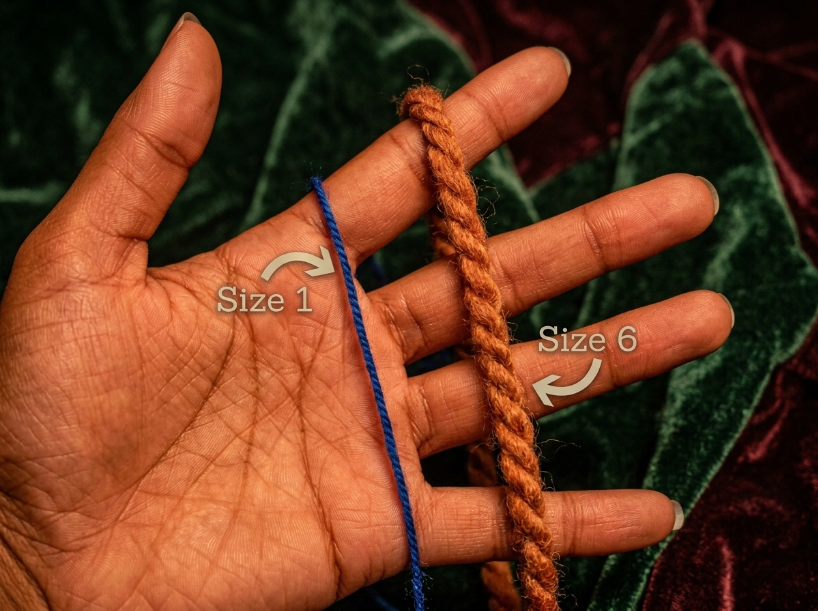
Yarn weight determines how quickly a project works up, how much yardage it requires, and whether the finished fabric will drape or hold its shape. The number printed on a yarn label tells you the thickness category, but it does not tell you whether that thickness is right for your project or your skill level.
The Short Answer
Match the yarn weight category on your pattern to the number on the yarn label. Most beginner patterns use worsted weight (category 4) because it works up at a visible pace and shows stitch definition clearly without requiring tight tension control.
Main Steps
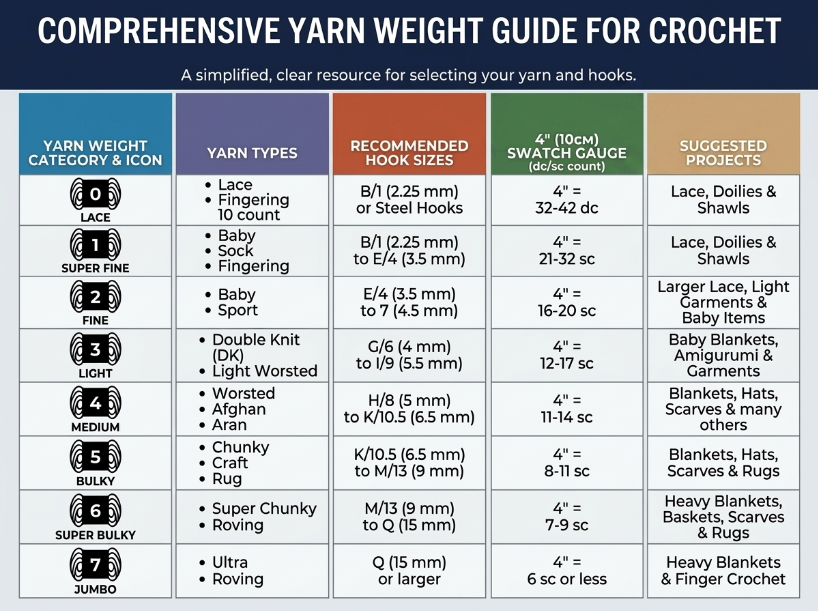
Start by checking the yarn label for the standardized weight number, which ranges from 0 (lace) through 7 (jumbo). The pattern will often specify a weight category, and for a straightforward substitution, choosing a yarn in the same category is the simplest approach. If the pattern calls for worsted weight, look for a 4 on the label. The recommended hook size range is printed directly below the weight number, usually in millimeters.
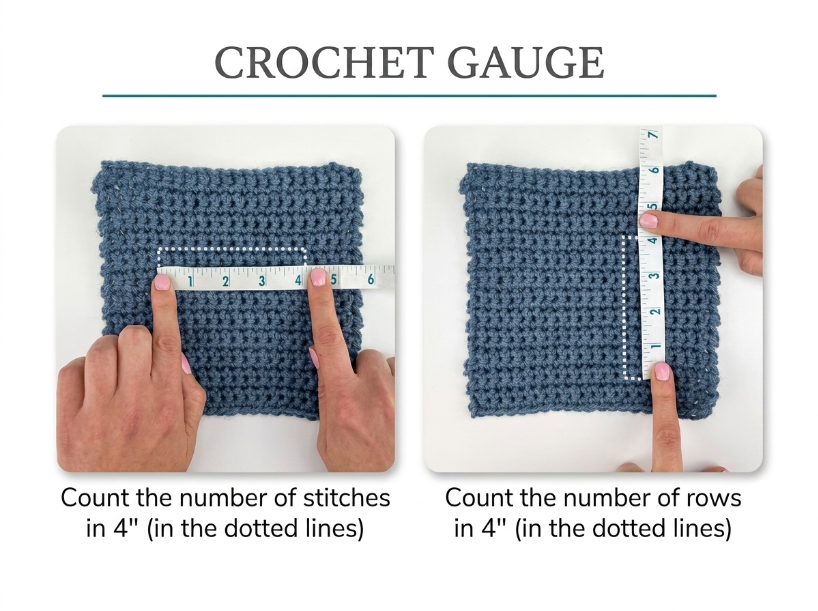
Most guides recommend working a gauge swatch before starting any project, and that advice holds true when the finished size matters. A gauge swatch measures 4 inches by 4 inches and tells you how many stitches and rows fit into that space using your specific yarn, hook, and tension. If your gauge does not match the pattern’s gauge, the finished piece will be larger or smaller than intended. That said, if you are making a scarf or a dishcloth where exact dimensions do not matter, you can skip the swatch and adjust as you go. How to Choose Yarn Size for Crochet (A Beginner’s Guide) walks through the full gauge-checking process when precision is required.
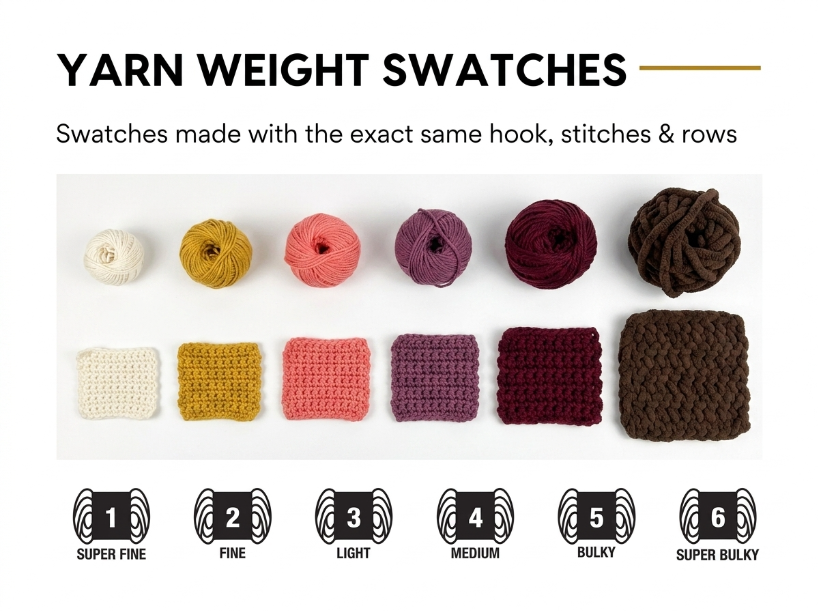
Thicker yarn works up faster because each stitch covers more area, and a project of the same finished size generally requires fewer linear yards, although the total amount of yarn used depends on the stitch, tension, yarn construction, and project dimensions. A blanket made with bulky yarn will often work up faster than the same blanket in worsted weight because each stitch covers more area, and it will generally require fewer total yards, although the exact difference depends on the stitch pattern and tension. Beginners often assume thicker yarn is easier, but the added bulk can make it harder to see individual stitches while you are learning.
| Step | What to do | Watch out for |
|---|---|---|
| Check the pattern’s yarn weight | Look for the weight category number (0-7) in the materials list | Patterns sometimes list yarn by brand name instead of weight category |
| Match the label number | Find the standardized weight symbol on the yarn label | Different brands may use slightly different thickness within the same category |
| Note the recommended hook size | Check the hook size range printed below the weight number | This is a starting point, not an absolute rule. Your tension may require adjusting up or down |
| Work a gauge swatch if size matters | Crochet a swatch according to the pattern’s gauge instructions, block it if the pattern calls for blocking, then measure stitches and rows | Measure after blocking, not immediately off the hook |
Comparison / Options
Worsted weight yarn is the most common starting point because it balances visibility and speed. The stitches are large enough to see clearly while you are learning, but not so bulky that mistakes become difficult to correct. Many beginner patterns use worsted weight (category 4), with hook sizes commonly around 5.5-6.5 mm, although the pattern’s recommended hook and gauge should take priority. These sizes fit comfortably in most hands without requiring the grip adjustments that smaller or larger hooks demand.
Bulky and super bulky yarn finish projects faster, which makes them appealing for beginners who want quick results. The catch is that thicker yarn amplifies tension inconsistencies. If your stitches are slightly loose in one section and slightly tight in another, the difference will be visible in the finished fabric. Worsted weight is more forgiving because the smaller stitch size smooths out minor tension variations. If speed is the priority and the project is decorative rather than fitted, bulky yarn works well. If you are learning stitch technique and want to see whether your tension is improving, worsted weight gives clearer feedback.
Fingering and sport weight yarn create delicate, drapey fabric, but they require more stitches per inch and take longer to complete. These lighter weights work well for shawls and summer garments where drape matters more than structure. In practice, most beginners find lighter weights frustrating because progress feels slow and the smaller stitches are harder to see. If you are drawn to a fingering weight pattern, consider starting with a small project like a washcloth rather than committing to a full garment. Yarn Under vs. Yarn Over: The Structural Guide to Crochet Stitch Anatomy explains how stitch structure changes with yarn thickness.
| Weight Category | Number | Best For | Drape vs Structure | Speed |
|---|---|---|---|---|
| Fingering | 1 | Lace shawls, summer tops | High drape, low structure | Slow |
| Sport | 2 | Lightweight garments, baby items | Moderate drape | Moderate |
| DK / Light Worsted | 3 | Lightweight garments, baby blankets | Moderate drape | Moderate |
| Worsted | 4 | Dishcloths, scarves, amigurumi | Balanced | Fast |
| Bulky / Super Bulky | 5-6 | Quick blankets, winter hats | Low drape, high structure | Very fast |
Common Mistakes
The most common mistake is assuming that any yarn within the same weight category will behave identically. Two worsted weight yarns can have different thicknesses depending on the brand, and acrylic worsted will drape differently than cotton worsted even if they are both labeled as category 4. Fiber content affects how the fabric hangs and whether it holds its shape after washing. Cotton generally has less stretch than acrylic, making it a popular choice for structured projects like bags and dishcloths. Acrylic has more give, which makes it better for large blankets where drape matters more than rigidity.
Another frequent issue is choosing yarn based on color or texture without checking whether the weight matches the pattern. A soft, appealing yarn in the wrong weight category will produce a finished piece that does not match the pattern’s dimensions or drape. If you fall in love with a yarn that is one category off from the pattern’s recommendation, you will need to adjust the hook size and recalculate the stitch count. That is doable, but it is not beginner-friendly.
Beginners often skip the gauge swatch because it feels like extra work, and for some projects, that is fine. Even so, if you are making a fitted garment or a blanket where size matters, skipping the swatch means you will not know whether your tension matches the pattern until you have already invested hours of work. A 4×4 inch swatch takes 10 minutes and can save you from ripping out an entire project.
Troubleshooting
If your finished piece is larger than the pattern specified, your stitches are too loose. The fix is to drop down one hook size and work another swatch. Loose stitches happen because the hook is too large for the yarn weight, allowing too much yarn to pull through each loop. Tightening your grip on the yarn can help, but changing the hook size is usually the more reliable solution.
If the fabric is smaller than expected and feels stiff, your tension is too tight. Move up one hook size and check the gauge again. Tight tension often happens when beginners grip the hook or yarn too firmly, which compresses the stitches and reduces the fabric’s flexibility. In practice, most beginners start with tight tension and gradually loosen up as they gain confidence. If your gauge is off by more than one stitch per 4 inches, the hook size adjustment alone may not be enough, and you will need to work on relaxing your grip.
If the yarn feels scratchy or uncomfortable to work with, the fiber content may not suit your hands. Acrylic yarns often feel smooth and glide easily, while some cotton yarns can feel less slippery or rougher during long sessions. A cotton-acrylic blend offers a middle ground, combining cotton’s structure with acrylic’s softness. The catch is that blends behave differently than pure fibers when blocked, so results vary depending on the blend ratio.
| Mistake | Why it happens | Fix |
|---|---|---|
| Finished piece is too large | Hook size is too large for the yarn, or tension is too loose | Drop down one hook size and work a new gauge swatch |
| Fabric feels stiff and curls | Hook size is too small, creating tight stitches | Move up one hook size and check gauge again |
| Project uses more yarn than expected | Yarn is thicker than the pattern’s recommendation, or tension is tight | Check the yardage per skein on the label and buy extra |
| Stitches are hard to see while working | Yarn is too thin for your current skill level | Switch to worsted weight or use better lighting |
Deciding Your Approach
For most beginners, worsted weight acrylic is the safest starting point. It is affordable, available in every color, and forgiving when you need to pull out stitches and redo a section. The stitches are large enough to see clearly without requiring the tight tension control that lighter weights demand. If your first project is a dishcloth or a scarf where exact size does not matter, worsted weight lets you focus on learning the stitch technique without worrying about gauge precision.
If the pattern specifies a different weight category, match it exactly rather than substituting. A pattern written for bulky yarn will typically produce a much smaller piece if worked in worsted weight, even if you adjust the hook size. The stitch count is calculated based on the yarn’s thickness, and changing the weight category usually requires recalculating the entire pattern. This is generally not beginner-friendly. If you want to use a different yarn, finding a pattern written for that weight category is the safer approach.
Cotton is a highly reliable choice for projects that need to hold their shape, like bags, dishcloths, and amigurumi. Acrylic works well for blankets, scarves, and garments where drape and softness matter more than structure. The fiber content affects how the finished piece behaves after washing, so if machine-washability is a priority, check the care instructions on the label before buying.
Questions You Might Still Have
Q: How should a beginner choose yarn size?
Check the yarn weight number on the pattern’s materials list, then match it to the number printed on the yarn label. Many beginner patterns use worsted weight (category 4), which commonly works with a 5.5-6.5 mm hook and produces visible stitches without requiring extremely fine tension control. If the pattern does not specify a weight category, use its recommended hook size, gauge, and yarn characteristics to help choose a suitable yarn.
Q: How much time does a gauge swatch take?
A 4×4 inch gauge swatch typically takes 10 to 15 minutes to crochet, depending on the stitch pattern and yarn weight. Blocking the swatch adds another 20 to 30 minutes if you are wet blocking, or about 5 minutes if you are steam blocking. The time investment is small compared to the hours you will spend on the full project, and a gauge swatch is the most reliable way to verify your tension before starting the project.
Q: Which hook size is best for a first project?
Many beginner patterns use worsted weight yarn (category 4) with a medium-sized hook, but the pattern’s recommended hook and gauge should take priority. This combination produces stitches that are easy to see and work at a comfortable pace. If the yarn label recommends a different hook size, use that as your starting point and adjust based on your gauge swatch. Hook size is one of the main factors affecting gauge, so you may need to adjust it up or down to match the pattern’s gauge.
Q: Why does my yarn choice look wrong?
The most frequent mistake is choosing yarn based on color or texture without checking whether the weight category matches the pattern. Another common issue is assuming that all yarns within the same weight category will behave identically, when fiber content affects drape and structure significantly. Beginners also tend to skip the gauge swatch, which means they do not discover sizing problems until the project is half finished.
Q: What should I do if my gauge is wrong?
If your gauge swatch has more stitches per 4 inches than the pattern specifies, your tension is too tight. Move up one hook size and work another swatch. If your swatch has fewer stitches per 4 inches, your tension is too loose. Drop down one hook size. Keep adjusting until your gauge matches the pattern within half a stitch per 4 inches. If your gauge is off, first check your tension and adjust the hook size as needed. If the yarn differs substantially from the pattern’s recommendation, you may also need to consider how the yarn’s weight and construction affect the result.
Q: Is there a faster way to pick yarn without swatching?
If exact size does not matter, you can skip the gauge swatch and choose yarn based on the weight category and fiber content alone. This works well for scarves, dishcloths, and decorative items where a few inches of variation will not affect the function. For fitted garments, blankets with specific dimensions, or amigurumi where proportion matters, checking your gauge before committing to the full project is the most reliable way to confirm that your yarn, hook, and tension will produce the intended size. There is generally no shortcut that produces highly accurate results.
📅 Last reviewed: August 2026 · This article is reviewed every 12 months.
Summary
Yarn weight determines how quickly a project works up, how much yardage it requires, and whether the finished fabric will drape or hold structure. Worsted weight is the most beginner-friendly option because it balances visibility and speed, but the right choice depends on the project’s function and the pattern’s gauge requirements. If exact size matters, work a gauge swatch before committing to the full project. If drape and softness are the priority, acrylic works well. If structure and shape retention matter more, cotton is often the better pick.

