


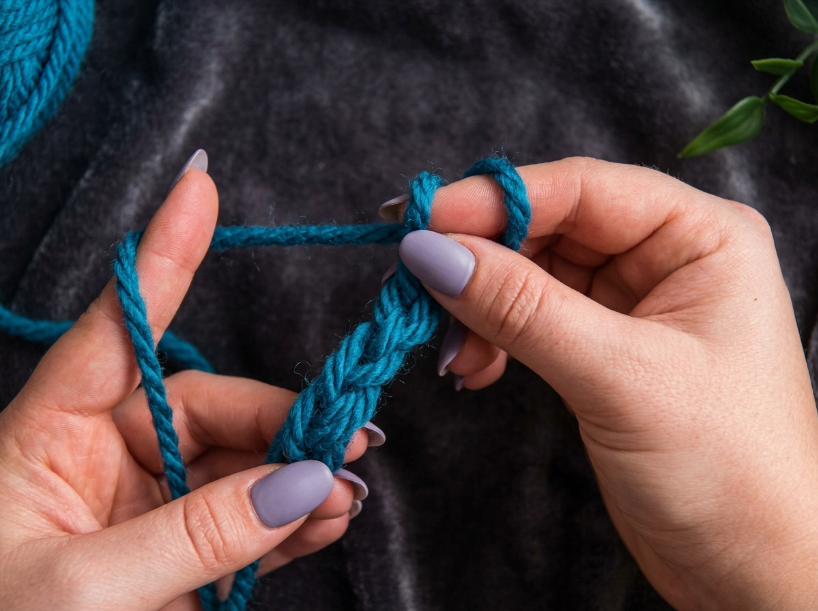
Finger crochet replaces the hook entirely, using the index finger to pull loops through yarn held in the hand. The technique creates a loose, open fabric and can work up quickly with bulky yarn, while finger-crochet methods can be used to make basic stitches such as single crochet, half-double crochet, and double crochet without a hook.
The Short Answer
Finger crochet uses your index finger as the working tool to pull new loops through existing loops. The fabric often comes out looser and more open than hook crochet because the finger typically creates larger loops than a conventional crochet hook. Bulky or super bulky yarn works best since thicker strands are easier to grip and manipulate by hand.
Main Steps
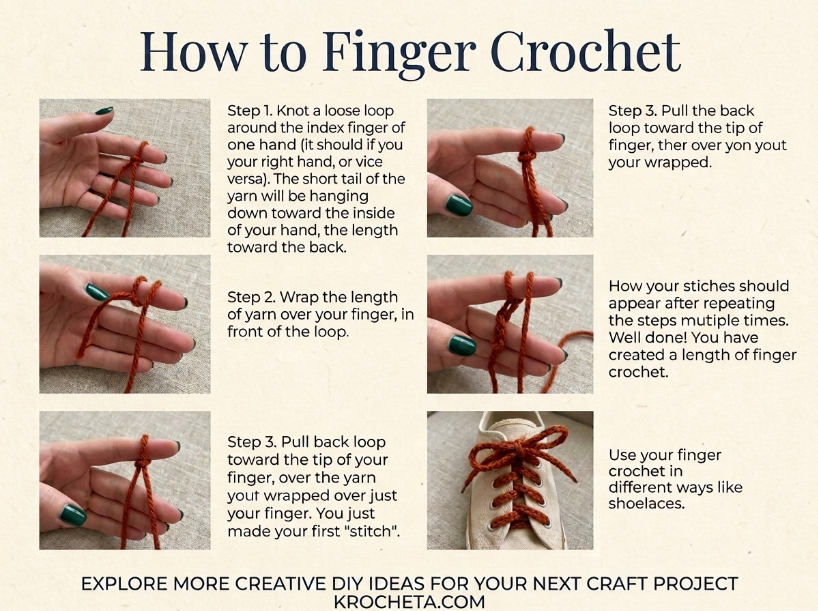
Most guides say to start with a slip knot and work a chain, which is correct for building a foundation. The slip knot sits around your index finger and serves as the starting loop for the foundation chain. You pull new loops through with the same finger motion. This works well for scarves and cowls where a loose, open fabric is desirable. In practice, while you can execute single crochet (SC), half-double crochet (HDC), and even double crochet (DC) with your fingers, highly complex lacework or intricate insertion points are difficult because an adult finger is much thicker than a standard hook.
Tension control comes from how tightly you pull each loop through. If you pull loosely, the fabric drapes more but loses definition. If you pull tightly, the stitches hold their shape better but the fabric becomes stiffer and harder to work with. Results vary significantly with yarn weight, fiber content, and how much natural give your hands allow. Acrylic and cotton have different elasticity and handling characteristics, so the same hand tension can produce fabrics with different amounts of stretch, drape, and recovery.
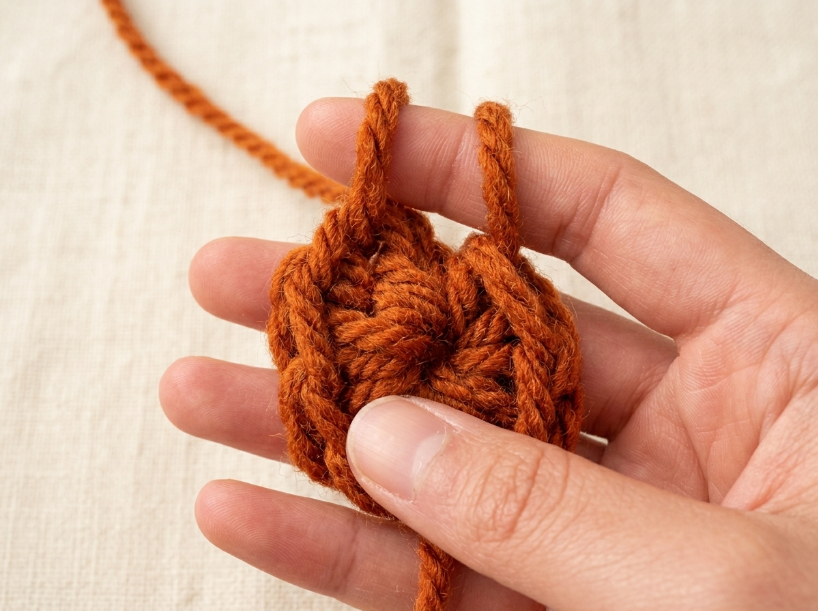
Fastening off requires pulling the yarn tail completely through the final loop to lock the work. If you skip this step or leave slack in the tail, the last few stitches can unravel.
| Step | What to do | Watch out for |
|---|---|---|
| Make a slip knot | Form a loop, pull the working yarn through, tighten around your index finger | Too tight restricts finger movement, too loose lets the loop slide off |
| Pull the first chain loop | Yarn over your index finger, pull through the slip knot, leave the new loop on your finger | Inconsistent loop size creates uneven fabric tension |
| Continue chaining | Repeat the yarn-over and pull-through motion, keeping loops uniform | Dropping loops mid-chain forces you to restart from the beginning |
| Fasten off | Pull the yarn tail completely through the final loop, tug firmly to lock | Leaving slack in the tail allows the last stitches to unravel |
Comparison / Options
Bulky weight yarn is the standard recommendation for finger crochet because the thick strands are easier to grip and the larger loops match the natural size your fingers create. Worsted weight can work, but the thinner yarn slips through your fingers more easily, making tension harder to control. If you are making a delicate accessory where bulk would look clunky, worsted weight with very careful tension can produce a finer fabric. However, your hands will likely tire faster from gripping the smaller strands.
Super bulky yarn speeds up the process even more than bulky, which is why it is a common choice for quick scarves and blankets. The extra thickness fills space faster and creates a bold, chunky texture. Even so, super bulky yarn can feel awkward to manipulate if your hands are small, and the resulting fabric may be too stiff for projects that need drape. If hand size is an issue, switching to bulky weight with a slightly looser tension gives you a similar look without the bulk.
Acrylic can be more forgiving than cotton for finger crochet because its elasticity can make the resulting fabric more flexible. Cotton generally has less elasticity and tends to hold its shape more firmly, which can make differences in loop size easier to see. Cotton’s low elasticity can be useful when you want a more stable fabric. If you are making a wearable that needs to stretch and recover, acrylic or a cotton-acrylic blend usually makes more sense.
Common Mistakes
The most common mistake is pulling loops too tightly in an attempt to make the fabric look more controlled. Tight loops do create more definition, but they also make it nearly impossible to pull the next loop through without straining your finger. The fabric ends up stiff and the process becomes frustrating. A better approach is to leave enough slack that your index finger can slide through each loop comfortably, even if the fabric looks looser than you expected at first.
Another frequent error is switching hands mid-project to rest a tired finger. This changes the tension direction and creates a visible shift in the fabric where the loop sizes suddenly become inconsistent. If your finger needs a break, stop at the end of a row rather than mid-row. The pause will not show in the finished piece as long as you resume with the same hand and the same tension level.
A common misconception is that finger crochet is only for chaining. You can actually perform standard stitches like single or double crochet by treating your index finger exactly like a hook-inserting it under the ‘V’ of the previous row and pulling up loops. That said, because your finger is substantially thicker than a typical crochet hook, attempting tight, intricate stitch patterns will be frustrating. If your project needs sharp stitch definition or tiny shaping, switching to a standard hook will give you better results.
Troubleshooting
If your loops keep slipping off your finger, the loop may be too loose, the yarn may be particularly slippery, or you may be making the loops larger than you can comfortably control. Tighten the initial loop so it sits snugly on your index finger without cutting off circulation. The loop should stay in place when you move your hand, but you should still be able to slide it off deliberately when fastening off. If tightening the foundation loop does not help, check whether your yarn is too slippery. Very smooth yarns can slide more easily than textured yarns, which may provide more grip on the finger.
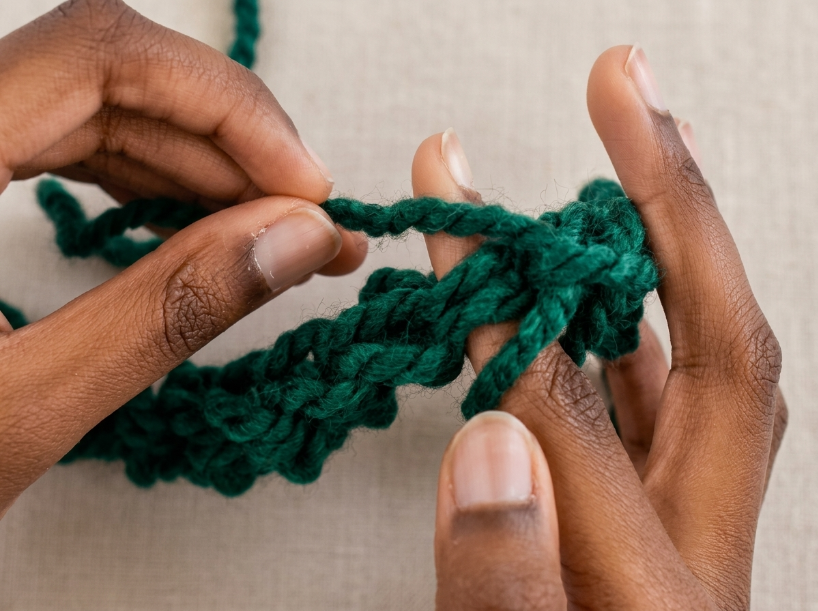
When the fabric curls inward at the edges, the problem is usually uneven tension across the row. Finger crochet often produces a looser gauge than conventional hook crochet, particularly when worked with bulky yarn and large finger-made loops, but if you pull some loops tighter than others, the fabric will warp toward the tighter side. The fix is to pause after every few loops and check that each new loop matches the size of the previous one. In contrast, if the entire piece curls uniformly, the yarn weight may be too light for finger crochet. Switching to a bulkier yarn often solves the issue without requiring you to adjust your technique.
If your hand cramps after a few rows, you are gripping the yarn too tightly or holding your finger at an awkward angle. Relax your hand between loops and let the yarn drape naturally across your palm instead of clenching it in your fist. The yarn should flow through your fingers with minimal resistance. If cramping persists, take regular breaks rather than pushing through discomfort. Finger crochet uses muscles that are not active in hook crochet, so building endurance takes time.
| Mistake | Why it happens | Fix |
|---|---|---|
| Loops slip off finger | Slip knot is too loose or yarn is too slippery | Tighten the foundation loop, switch to a textured yarn with more grip |
| Fabric curls inward | Uneven tension across the row or yarn weight is too light | Match loop sizes carefully, use bulky or super bulky yarn |
| Hand cramps quickly | Gripping the yarn too tightly or holding finger at awkward angle | Relax hand between loops, take regular breaks |
| Stitches unravel after fastening off | Yarn tail not pulled fully through final loop | Pull the tail completely through and tug firmly to lock the last stitch |
Additional Tips
For a first project, a simple scarf or cowl makes the most sense because the open, stretchy fabric finger crochet produces works well for wearables. Blankets can also be suitable for beginners, although their large size means they require considerably more yarn and working time. If you want a highly structured piece like a firm bag or basket, conventional hook crochet will usually give you more control over stitch density and shaping. The loose gauge can make it harder to achieve the firm, stable fabric needed for projects that must support significant weight.
If budget is the priority, acrylic is the most affordable option and works well for learning the technique. If you want a finished piece that feels premium and holds its shape better, a cotton-acrylic blend offers more structure without the stiffness of pure cotton. For a luxury feel, wool or wool-blend bulky yarn drapes beautifully and has natural elasticity that makes tension easier to control.
The decision between finger crochet and hook crochet comes down to the project’s requirements. If you need a fast, casual piece with a chunky texture and do not care about stitch definition, finger crochet works. If you need shaping, stitch variety, or a denser fabric, a hook gives you far more control. Finger crochet offers less precision than a standard crochet hook, particularly for small stitches, tight fabrics, and intricate stitch patterns.
Questions You Might Still Have
Q: What is the best way to practice finger crochet?
Start with super bulky acrylic yarn and work a simple chain until you can make uniform loops without looking at your hands. Once the chain feels consistent, try a basic scarf by working back and forth in rows, pulling each new loop through the loop from the previous row. Avoid patterns that require counting stitches or inserting your finger into specific parts of a stitch until you have built muscle memory for the basic pull-through motion.
Q: How long does finger crochet take?
A simple scarf can be completed relatively quickly with super bulky yarn, although the total time depends on its size, stitch pattern, yarn weight, and your working speed. Blankets can also be suitable for beginners, although their large size means they require considerably more yarn and working time. Timing varies widely based on yarn weight, project size, and how often you need to pause to rest your hand.
Q: What yarn weight is best for finger crochet?
Finger crochet does not use a hook at all. The technique relies entirely on your index finger to pull loops through. Bulky or super bulky yarn is the standard recommendation because thicker yarn is easier to grip and manipulate by hand. Worsted weight can work but requires more effort to control tension and produces a thinner fabric that may not suit the technique’s naturally loose gauge.
Q: Why does my finger crochet look wrong?
Pulling loops too tightly is the most frequent error because it makes the next loop nearly impossible to pull through and creates a stiff fabric. Switching hands mid-row changes the tension direction and causes visible inconsistency. Trying to execute tight, intricate stitch patterns often fails because the finger is substantially thicker than a typical crochet hook, making it difficult to achieve tight precision.
Q: How do I fix a dropped loop in finger crochet?
If a loop slips off, you can simply insert your index finger back into the live loop, just as you would reinsert a hook. In practice, if the loop pulls out entirely, you will have to unravel back to the last secure loop. If the fabric curls or looks uneven, the fix is to adjust your tension for the next project rather than trying to correct finished rows.
Q: Is arm knitting faster than finger crochet?
Arm knitting can produce larger loops and may work quickly with very bulky yarn, but speed depends on the technique, yarn, project size, and the person working it. The two techniques also produce different fabrics, so speed is not the only consideration.
📅 Last reviewed: August 2026 · This article is reviewed every 12 months.
Summary
Finger crochet trades precision for speed and simplicity, making it well suited to casual, open-weave projects where highly defined stitches are not the priority. Bulky or super bulky yarn works best because thicker strands are easier to manipulate by hand, and the loose gauge the technique produces suits scarves, cowls, and blankets more than structured pieces. While it can successfully replicate standard stitches like single and double crochet, the technique cannot easily produce tight, intricate fabrics due to the natural thickness of a finger. Once you understand that finger crochet is a tool for speed and texture rather than precision, choosing when to use it becomes straightforward.

